
'Patel was more in tune with the popular mood than Jawaharlal Nehru. While the principle that Hindus and Muslims should be able to live together remained central to Nehru's vision for India, the Sardar was less sentimental.' 'Nehru would angrily face down mobs himself, rushing from trouble spot to trouble spot. A veritable tent city, filled with Muslim refugees, sprouted on the lawns of his bungalow... Mountbatten feared Nehru's impulsiveness would get him killed, and assigned soldiers to watch over him.' Nisid Hajari's Midnight's Furies: The Deadly Legacy of India's Partition casts fresh light on the events and personalities behind the horrific division of the subcontinent which haunts the India and Pakistan to this day.
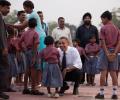
US president was unaware that the son of a manual labourer had to abandon studies

'For India, the phase of pure restraint has passed.' 'Restraint has failed to reform Pakistan or rein in terrorism,' says Vivek Gumaste.

'The most valuable personal sensitive information of present and future citizens has been made available to foreign data firms and governments and non-State actors for all time to come,' says Gopal Krishna.

The murders of journalists in 2015 underscore the rising power of regional language media, especially local-language newspapers, says Nilanjana S Roy
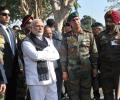
'If India employed a strategy of a 'thousand cuts', Pakistan will wither away.'

Asserting that chemical weapons were used in Syria by the embattled Assad regime, US Secretary of State John Kerry termed the last week's attack that killed over 300 civilians a "moral obscenity" that should shock the conscience of the world.

News of all that's transpired on and off the football field

Consent isn't a privilege; it is a basic human right.

'The most difficult part of film-making is dealing with people you are working with and trying to forget the drama that goes behind the scenes.'

'Those who have followed politics even when there was no Twitter know what the word 'jumlebaaz' means,' says Utkarsh Mishra.

'We are completely engaged in fighting poverty; alas, our neighbour Pakistan seems only engaged in fighting us.'

Dr Kalyani Gomathinayagam, a young Indian doctor who volunteered to spend four weeks in west Africa helping those suffering and dying of Ebola, speaks to Vaihayasi Pande Daniel/Rediff.com why she took on an assignment many would shy away from.
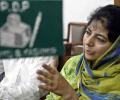
Kashmir's youth are being radicalised. The once-alienated separatists are ready to return to their old haunting ground. The ruling PDP-BJP coalition finds itself on the defensive over almost every issue of governance.
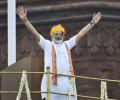
Following is the full text of Prime Minister Narendra Modi's address from the ramparts of the Red Fort on the 73rd Independence Day.

Hamid Anasari's was not talking of reservation for the whole religious community to which he too happens to belong. Yet, sections of media chose to put words into his mouth and then subject him to the criticism he never deserved. This does not augur well for our media or democracy, says Mohammad Sajjad.

'The sense of urban loneliness is felt most in the modern residential complexes. To be in the neighbourhood does not make one a friendly neighbour, so while one may appear friendly does not mean one is a friend. I am alarmed at the rate at which we Indians have grown away from some old systems that were ingrained in our society,' says N Suresh.

As Myanmar refuses to accept that the boat-loads of refugees abandoned at mid-sea are its people, claiming instead that they are from Bangladesh, the plight of the Rohingyas has worsened, reports Prakash Bhandari from Dhaka.

'The 'Off-with-Rajan's-head' brigade bases its arguments on mistaken beliefs, erroneous causalities, and even downright prejudice.'

'It would be a folly on our part to believe that the KKK or its Indian version exists only as some dedicated organisation. Rather, the Indian KKK, much like the American counterpart, exists as a fragmented and amorphous collection of independent groups and individuals,' says Shehzad Poonawalla.
'Terrorism has no place in our religion, society or in our daily lives.'

The winners of the 60th annual World Press Photo Contest have been announced. The winning shot was taken by Turkish Associated Press photographer called Burhan Ozbilici, with an image he has simply titled An Assassination in Turkey. Showing Mevlut Mert Altintas shouting after shooting Andrei Karlov, the Russian ambassador to Turkey, at an art gallery in Ankara, Turkey, on December 19 2016.

'India and Indian Americans cannot rely on wishful thinking about the checks and balances in the US system to magically take care of the many dangerous things that Trump could do,' says Chicago-based writer Ram Kelkar.

Vat Vrikshya -- banyan tree in Sanskrit -- helps tribal women, with absolutely zero formal education, set up businesses.

'Coordination between our 50 teams, each with a strength of 45 men, played a key role in rescuing flood-affected people in Chennai. In all, we succeeded in rescuing over 20,000 people.'

How will the return of a majority government at the Centre, the new India-US friendship and the Mangalyaan triumph change India?

There are 2.5 lakh undocumented Indians across the United States. While President Barack Obama's executive order last week does help, only the US Congress can really address the needs of those caught in the immigration tangle.

Pablo Bartholomew, the legendary Indian photojournalist whose searing images from the Bhopal gas tragedy stunned a nation's conscience 30 years ago, speaks to Vaihayasi Pande Daniel/Rediff.com.
'Even if Akhilesh Yadav opens up the entire state treasury for us we will not vote for the Samajwadi Party... ''...I don't want to return to my village, my head will be chopped off. They want me to press the button on the lotus.' Caught between an aggressive BSP cornering Dalit votes and the BJP cornering other Hindu votes, the Muslims of Muzaffarnagar have nowhere to go, no one to turn to. Rediff.com's Sheela Bhatt presents the grim situation on the ground in western Uttar Pradesh.

'If you invest your entire capital in talks, you cannot abruptly change gear and decide on war.'

'It is for the first time the voices of the most deferred, the most neglected, the most ignored, the most abused, the most vulnerable - the children-- has been heard. It is a great moment.' 'I always wanted Pakistan and India to have good relationships because I believe that this is very important for the development of both the countries.' 'If children are taught hatred, if they are taught about sectarianism and prejudice, then we can see that there will be terrorism in society." Nobel Peace Prize winners Kailash Satyarthi and Pakistan's Malala Yousafzai were given an ovation after they delivered their rousing speeches in front of a packed audience at a glittering ceremony in Oslo on Wednesday. A day later, they sit down for an interview with CNN's Christiane Amanpour and share their dreams, their hopes for the future. Read excerpts from the interview.
The eye of the debate has been focused too tightly on the quantum of punishment rather than the current approach, both to the juvenile, and also, for making him/her accountable, says Puja Marwaha

PM Modi addressed a crowded UNESCO gathering, speaking of the importance of culture.

'Modi wants to be pragmatic -- acknowledge the problem of Pakistan and that full reconciliation is essentially a non-starter, but at the same time grab the low-hanging fruits (such as trade) to put things on a more even keel, to engender enough stability in the relationship to allow him to focus on other priorities.'

In an online chat with Get Ahead readers Love Guru answered their relationship queries.
